Blueprint #2 – Industrial Streaming Architecture
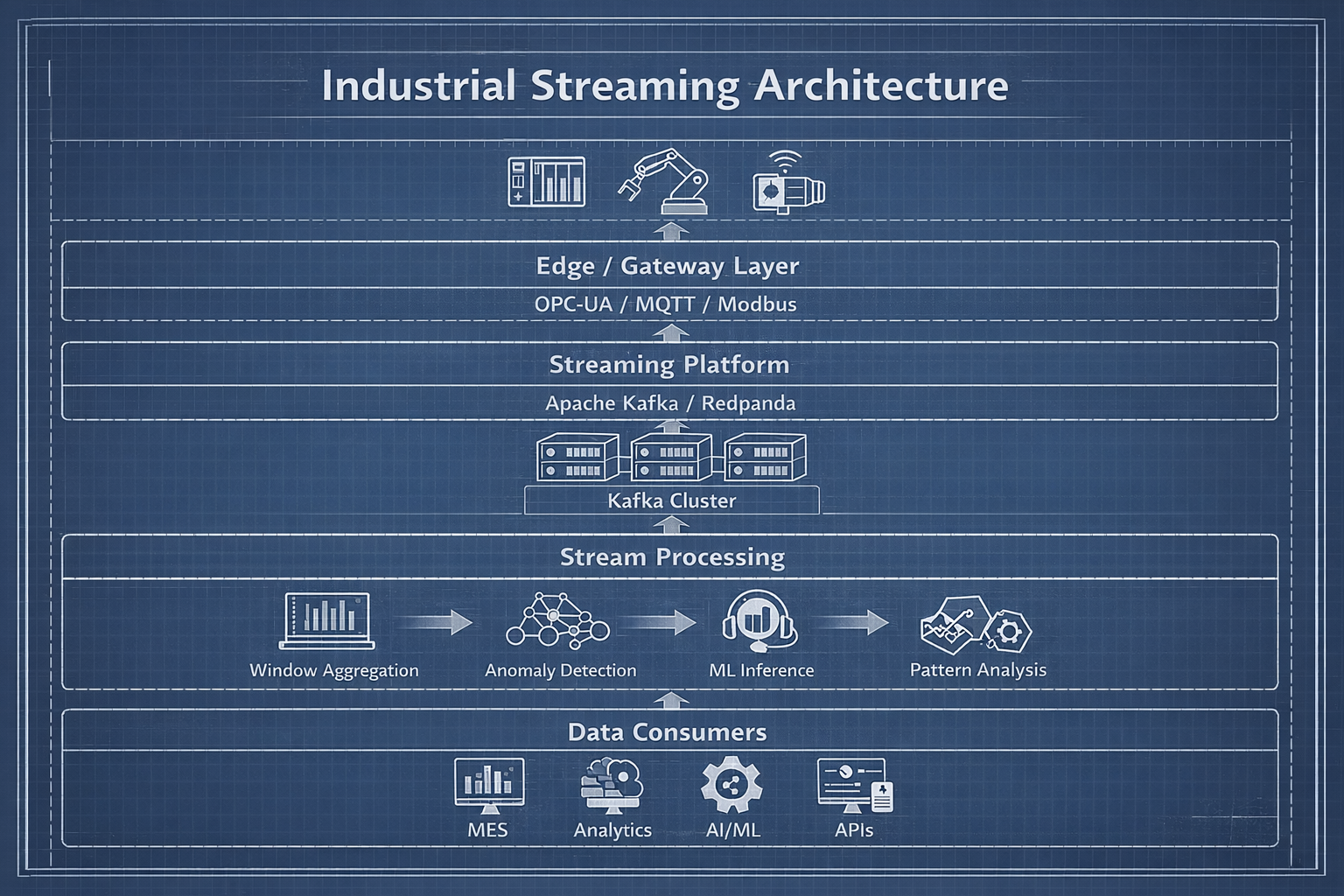
Blueprint #2 - Industrial Streaming Architecture
Industrial environments generate continuous, high-velocity operational data from PLCs, sensors, robots, MES systems, and industrial gateways.
To build a real-time smart factory, this data must be processed as streams rather than batches.
This blueprint describes a production-grade Industrial Streaming Architecture that enables:
- Real-time machine monitoring
- Predictive maintenance
- Digital twin updates
- Quality anomaly detection
- Event-driven manufacturing systems
This architecture is designed for scalability, resilience, and operational observability in modern smart factories.
1. Why Streaming Architecture in Manufacturing
Traditional manufacturing systems rely heavily on periodic batch processing.
Typical legacy flow:
PLC → SCADA → Historian → Batch ETL → Analytics
Problems:
- High latency (minutes to hours)
- Poor real-time visibility
- Limited event-driven automation
- Difficult scalability
Industrial streaming solves these limitations.
Real-Time Data Flow
Machines / Sensors │ ▼ Industrial Gateway │ ▼ Streaming Platform │ ▼ Real-time Processing │ ▼ Operational Systems / Analytics
This enables:
- millisecond-level data propagation
- event-driven manufacturing
- real-time operational intelligence
2. High-Level Architecture
A scalable Industrial Streaming Architecture typically consists of the following layers. 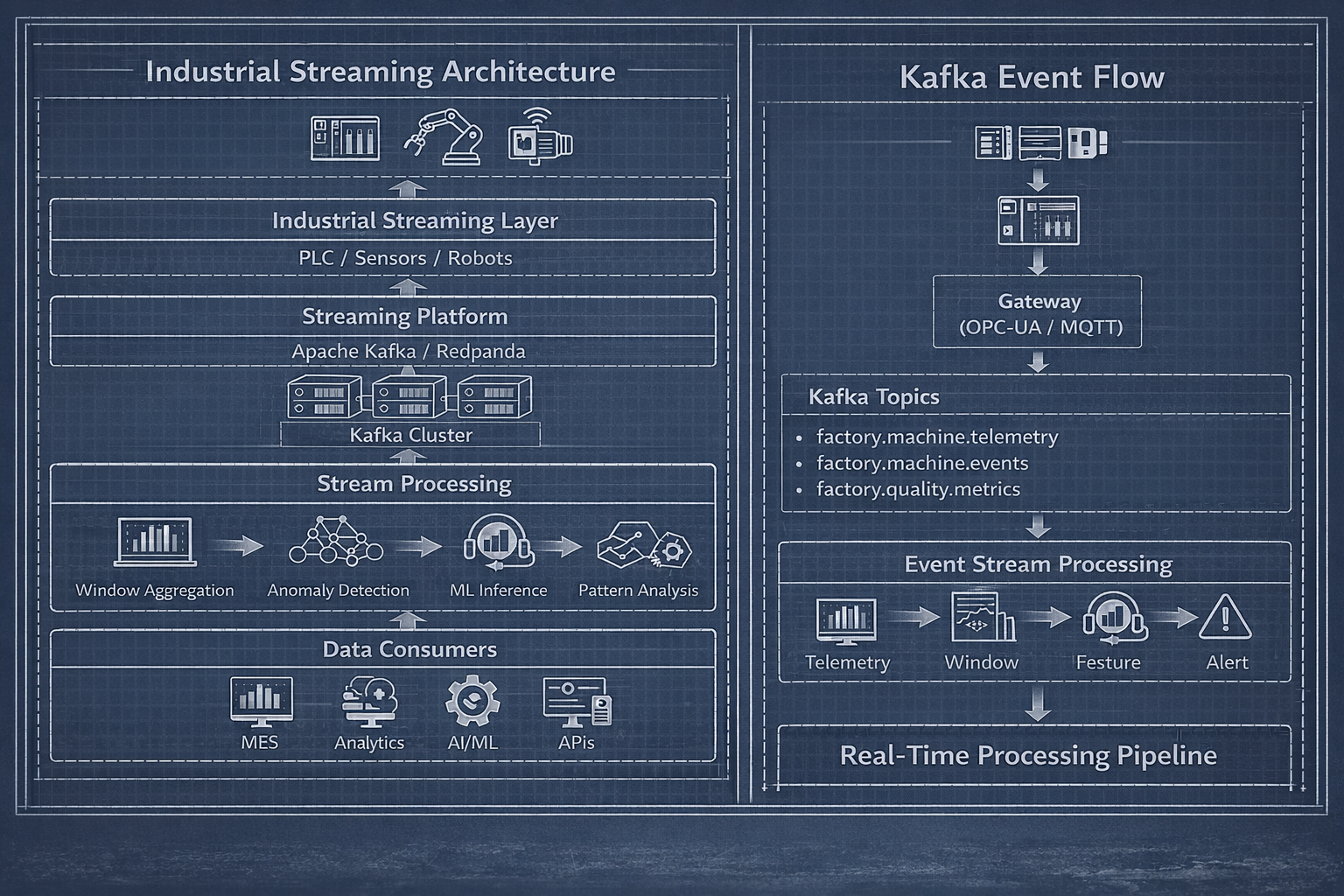
Each layer has a clear responsibility boundary, which is critical for maintainability.
3. Industrial Data Ingestion Layer
The ingestion layer connects OT environments to the IT data platform.
Common Industrial Protocols
| Protocol | Purpose |
|---|---|
| OPC-UA | Industrial interoperability |
| MQTT | Lightweight IoT messaging |
| Modbus | Legacy industrial communication |
| Profinet / EtherNet/IP | Real-time industrial networking |
Example gateway flow:
PLC → OPC-UA → Edge Gateway → MQTT → Kafka
Typical edge stack:
Industrial Device │ ▼ Edge Gateway ├ OPC-UA Collector ├ MQTT Client ├ Protocol Converter └ Local Buffer
Edge buffering is essential to handle network interruptions.
4. Streaming Platform (Kafka Backbone)
The streaming backbone provides durable event streaming.
Common choices:
- Apache Kafka
- Redpanda
- Pulsar
Typical Kafka cluster architecture:
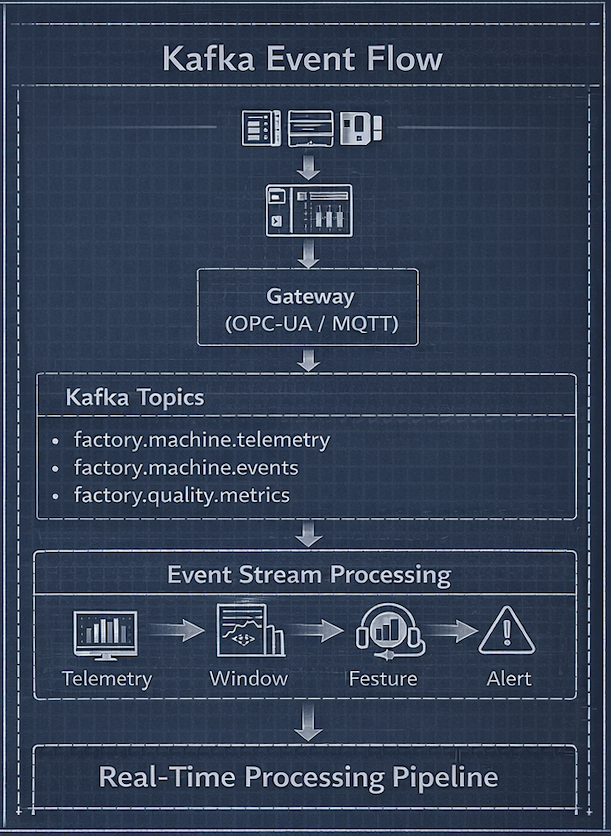
Key Kafka configuration concepts:
Topic Design
Example topics:
factory.machine.telemetry factory.machine.events factory.quality.metrics factory.energy.usage
Partition Strategy
Partition by:
machine_id production_line factory_site
This enables parallel stream processing.
5. Stream Processing Layer
Streaming processing enables real-time computation.
Typical frameworks:
| Framework | Use Case |
|---|---|
| Kafka or Apache Flink | complex event processing |
| Kafka Streams | lightweight streaming |
| Spark Structured Streaming | large-scale pipelines |
Example real-time analytics:
Machine Telemetry Stream │ ▼ Window Aggregation │ ▼ Anomaly Detection │ ▼ Alert Event
Example Flink processing flow:
Kafka Topic │ ▼ Stream Processor ├ Window Aggregation ├ Pattern Detection ├ Feature Extraction └ ML Inference │ ▼ Output Streams
6. Real-Time Manufacturing Use Cases
Industrial streaming architectures enable multiple high-value capabilities.
6.1 Predictive Maintenance
Sensor Data → Feature Extraction → ML Model → Failure Prediction
Benefits:
- Reduced downtime
- optimized maintenance schedules
6.2 Real-Time OEE Monitoring
Streaming enables continuous OEE computation.
Vision System Events │ ▼ Streaming Processor │ ▼ Defect Pattern Detection │ ▼ MES Alert
6.4 Digital Twin Synchronization
Physical Machine State │ ▼ Streaming Platform │ ▼ Digital Twin Update
This keeps the digital model synchronized with the factory floor.
7. Data Storage Strategy
Streaming architectures typically use multiple storage systems.
Streaming Data │ ▼ Hot Storage → Real-time analytics │ ▼ Warm Storage → Operational reporting │ ▼ Cold Storage → Historical analysis
Example stack:
| Layer | Technology |
|---|---|
| Hot | ClickHouse / Druid |
| Warm | RDBMS(Mysql,OpenDataBase, etc |
| Cold | Data Lake (AWS S3 / HDFS) |
8. Reliability and Fault Tolerance
Industrial systems require high availability.
Key design strategies:
At-Least-Once Delivery
Producer → Kafka → Consumer
Messages are never lost, but duplicates may occur.
Exactly-Once Processing
Supported by:
- Kafka transactions
- Flink checkpointing
Edge Buffering
Edge gateways should provide local persistence.
Network Failure │ ▼ Local Edge Buffer │ ▼ Retry Streaming
9. Observability for Streaming Systems
Streaming platforms require strong monitoring.
Typical metrics:
- consumer lag
- message throughput
- processing latency
- error rates
Monitoring stack example:
Kafka Metrics → Prometheus → Grafana
Alert examples:
- consumer lag > threshold
- processing latency spike
- broker disk usage
10. Security Considerations
Industrial streaming systems must protect both IT and OT environments.
Key security layers:
Device Authentication │ ▼ Encrypted Transport (TLS) │ ▼ Kafka Authentication (SASL) │ ▼ Access Control (ACL)
Network segmentation is strongly recommended.
OT Network │ ▼ Industrial DMZ │ ▼ IT Data Platform
11. Reference Technology Stack
Example production stack:
| Layer | Technology |
|---|---|
| Edge Gateway | MQTT |
| Streaming | Apache Kafka |
| Processing | Apache Flink |
| Storage | Timeserise + ASW S3 |
| Monitoring | Prometheus + Grafana |
| Orchestration | Kubernetes |
12. Key Architecture Principles
A robust industrial streaming architecture should follow these principles:
Event-Driven Design
Everything is modeled as events.
MachineStarted MachineStopped QualityAlert MaintenanceRequired
Decoupled Systems
Producers and consumers remain independent.
Producer → Kafka → Multiple Consumers
Scalability by Partitioning
Throughput grows with topic partitions and processing nodes.
Conclusion
Industrial streaming architectures are a core foundation for modern smart factories.
By enabling real-time data pipelines, manufacturers can achieve:
- predictive operations
- real-time decision making
- automated production responses
- continuous operational intelligence
This blueprint provides a reference architecture for building scalable streaming systems in industrial environments.
Next Blueprint
The next blueprint explores how real-time industrial data becomes an AI platform.
➡ Blueprint #3 — Industrial AI Platform Architecture
We will cover:
- ML pipelines for manufacturing
- feature stores
- model deployment in factories
- MLOps for industrial environments
Smart factories are built on data pipelines + streaming systems + AI platforms.
This blueprint is the streaming backbone of that architecture.