Industrial IoT on AWS #1 – Industrial IoT + AWS Cloud based Network + Data Platform Integration Architecture
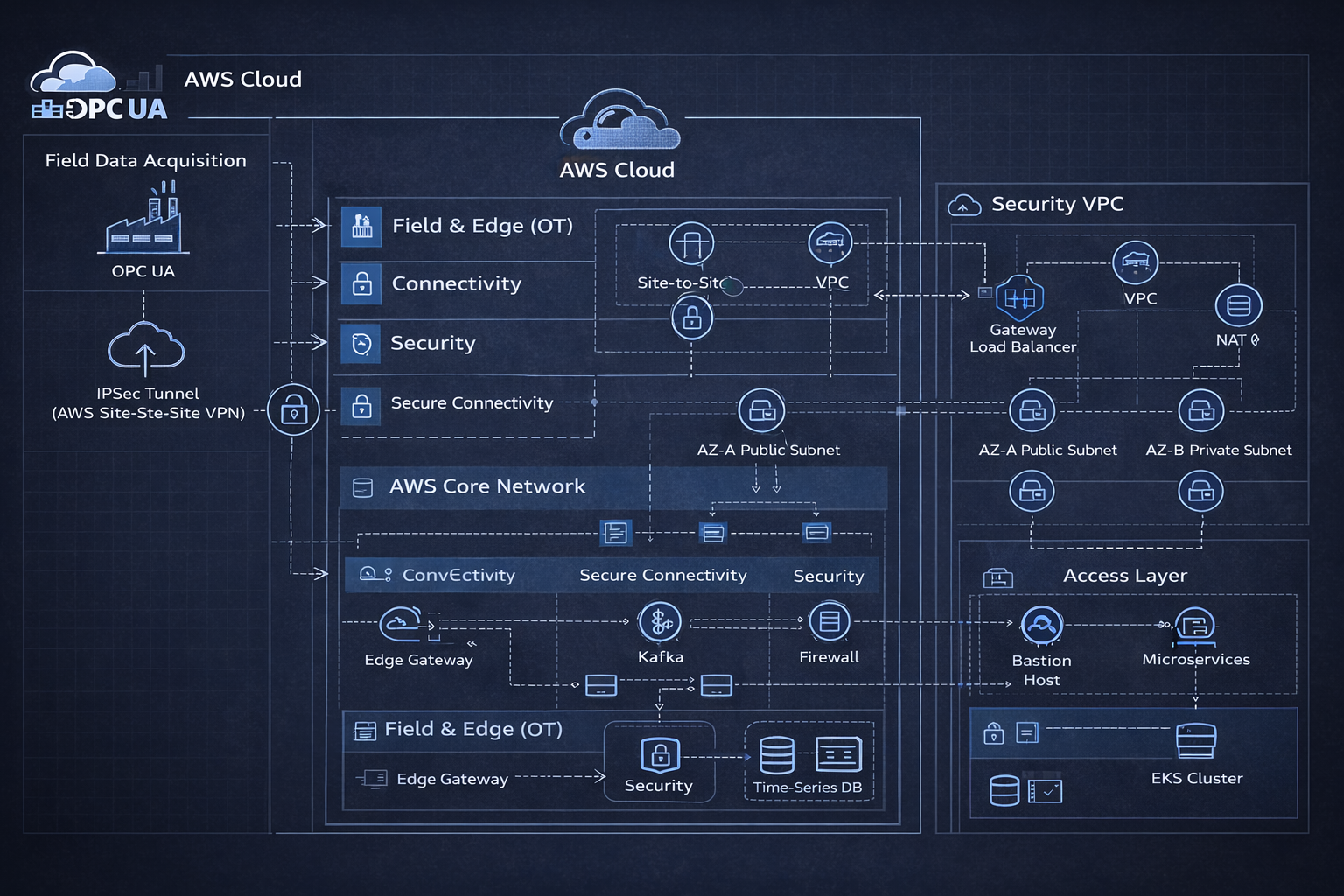
Industrial IoT on AWS #1 – Industrial IoT + AWS Cloud based Network + Data Platform Integration Architecture
1. Introduction
Industrial IoT goes beyond simple data collection.
It enables:
- Real-time analytics
- Predictive insights
- Automated decision-making
This architecture is designed with the following objectives:
- OT (Factory) to Cloud integration
- Secure network architecture
- Real-time streaming data platform
- Cloud-native scalability
2. Architecture Goals
2-1. Secure Connectivity
- Establish secure communication between OT and Cloud
2-2. Real-time Data Processing
- Kafka-based streaming architecture
2-3. High Availability
- Multi-AZ fault-tolerant design
2-4. Scalable Platform
- Container-based scalable infrastructure
3. Architecture Layers
3-1. Field & Edge (OT Layer)
- OPC-UA based data collection
- PLC / Sensors / SCADA systems
Key Points
- Supports legacy OT protocols
- Entry point for Edge-to-Cloud data flow
3-2. Secure Connectivity Layer
- IPSec Site-to-Site VPN
- Firewall
Key Service
- AWS Site-to-Site VPN
Key Points
- Maintains isolated OT network
- Minimizes external exposure
3️-3. Security Inspection Layer
- GWLB (Gateway Load Balancer)
- NGFW (Next-Gen Firewall)
Key Service
- AWS Gateway Load Balancer
Key Points
- Centralized security policy
- Full traffic inspection
3-4. AWS Core Network (VPC)
- Multi-AZ (e.g., us-east-1a / 1c)
- Public / Private subnet separation
- NAT Gateway + ALB
Key Services
- Amazon VPC
- AWS NAT Gateway
- Elastic Load Balancing
Key Points
- Private-centric architecture
- High availability networking
3-5. Streaming Platform (Event Layer)
- MSK (Kafka Cluster)
- Producer / Consumer model
Key Service
- Amazon MSK
Key Points
- Real-time event streaming
- Decoupled architecture
3-6. Data Platform Layer
- Time-series DB (InfluxDB)
- Relational DB (MySQL)
- Metadata management
Key Points
- Structured OT data
- Foundation for analytics & ML
3-7. Application & Compute Layer
- Kubernetes-based microservices
Key Service
- Amazon EKS
Key Points
- Scalable services
- API / Backend / AI processing
3-8. Access Layer
- Bastion Host
Key Points
- Secure administrative access
- Jump server pattern
4. End-to-End Data Flow
- Equipment generates data (OPC-UA)
- Data passes through Firewall → VPN
- Traffic is inspected via GWLB + NGFW
- Securely enters AWS VPC
- Streamed through Kafka (MSK)
- Stored in databases (InfluxDB / MySQL)
- Processed by EKS-based services
- Delivered to dashboards and external systems
5. Security Architecture
5-1. Network Security
- Private connectivity via VPN
- Subnet segmentation
5-2. Traffic Control
- GWLB + NGFW inspection
5-3. Access Control
- Bastion Host access
- IAM-based permissions
6. High Availability Design
6-1. Multi-AZ Architecture
- Availability Zone redundancy
- Distributed Kafka brokers
- EKS node distribution
6-2. Fault Tolerance
- Redundant NAT Gateways
- Load Balancer failover
7. Key Design Principles
- Secure by Design
- Event-driven Architecture
- Cloud-native (EKS)
- Decoupled System (Kafka)
8. Industrial Use Cases
- Smart Factory Monitoring
- Predictive Maintenance
- Energy Optimization
- MES Integration
9. Architect’s Summary
“OT → Secure Network → Streaming → Data Platform → Application”
Key highlights of this architecture:
- Reliable OT-to-Cloud integration
- Kafka-driven data flow
- Scalable EKS-based services
- GWLB-centered security model
10. Series Roadmap
This post is the entry point of the full series.
| Series | Topic |
|---|---|
| #1 | Architecture Overview |
| #2 | Data Pipeline Architecture |
| #3 | Streaming Architecture (Kafka/MSK) |
| #4 | AI / Analytics Platform |
| #5 | MLOps & Edge Deployment |
| #6 | Closed-loop Optimization |
Next Step
Industrial IoT on AWS #2 – Data Pipeline Architecture
Final Notes
This architecture has been optimized for:
✔ Blog Readability
- Simplified structure
- Layer-based organization
- Ready for publishing
✔ Series Consistency
- Fully aligned with Blueprint #1–#6
- Seamless expansion into Kafka, EKS, and AI
- Strong linkage to upcoming posts
Recommended Next Steps
Build the next series based on this foundation:
- #2 Data Pipeline (S3 / Lambda)
- #3 Streaming (MSK Deep Dive)
- #4 AI Platform (SageMaker)
This will complete your Architect-level portfolio.
This post is licensed under CC BY 4.0 by the author.