Blueprint #3 – Industrial AI Platform Architecture
Smart Factory Blueprint Series
Industrial systems are rapidly evolving from data collection platforms into AI-driven intelligent systems.
In the previous blueprints we explored:
- Blueprint #1 — Industrial Data Pipeline Architecture
- Blueprint #2 — Industrial Streaming Architecture
Those architectures focused on data ingestion and real-time processing.
However, the real value of industrial data emerges when it is used to power Artificial Intelligence systems.
This blueprint explains how to design a production-grade Industrial AI Platform Architecture that enables scalable machine learning in manufacturing environments.
The Role of an Industrial AI Platform
Industrial AI platforms transform operational data into actionable intelligence.
They enable organizations to:
- train machine learning models
- deploy models into production
- perform real-time inference
- monitor model performance
- manage the entire ML lifecycle
Without a proper platform, many industrial AI initiatives fail due to:
- fragmented infrastructure
- lack of deployment pipelines
- absence of monitoring
- difficulty scaling AI solutions
A well-designed platform enables reliable and scalable industrial AI systems.
Industrial AI Architecture Overview
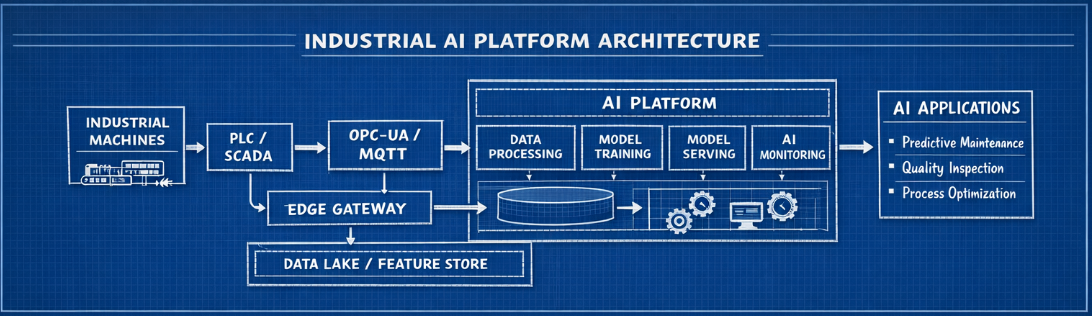
Industrial AI platforms sit on top of the industrial data infrastructure.
The data flow typically follows this pattern:
Industrial Machines ↓ PLC / SCADA ↓ OPC-UA / MQTT ↓ Edge Gateway ↓ Streaming Platform (Kafka) ↓ Data Lake / Feature Store ↓ AI Platform ↓ AI Applications
This layered architecture separates data ingestion, processing, training, and inference, making the system scalable and maintainable.
Core Components of the Industrial AI Platform
The Industrial AI platform consists of several critical layers.
1. Data Layer
AI systems rely heavily on large volumes of high-quality data.
Industrial data sources typically include:
- sensors
- PLC signals
- SCADA historians
- MES systems
- quality inspection systems
Typical technologies used in the data layer:
| Component | Technology |
|---|---|
| Data Lake | S3 / HDFS |
| Streaming | Kafka |
| Query Engine | Trino / Athena |
| Data Warehouse | Snowflake / Redshift |
This layer provides the historical datasets required for machine learning training.
2. Feature Engineering Layer
Raw industrial data must be transformed into meaningful features before being used for AI.
Examples of industrial features:
- rolling vibration averages
- equipment utilization metrics
- temperature gradients
- frequency spectrum components
Feature engineering pipelines are commonly built with:
- Apache Spark
- Apache Flink
- Kafka Streams
- Python pipelines
A Feature Store is often introduced to store reusable ML features.
Popular feature store technologies include:
- Feast
- Hopsworks
- Tecton
Feature stores help maintain consistency between training and inference data.
3. Model Training Platform
Machine learning training requires scalable compute infrastructure.
Typical environments include:
- Kubernetes clusters
- GPU nodes
- distributed training frameworks
Common tools include:
| Component | Tool |
|---|---|
| Training framework | PyTorch / TensorFlow |
| Experiment tracking | MLflow |
| Pipeline orchestration | Kubeflow / Airflow |
| Data versioning | DVC / LakeFS |
These tools help manage experiments and ensure reproducibility.
Industrial MLOps Pipeline
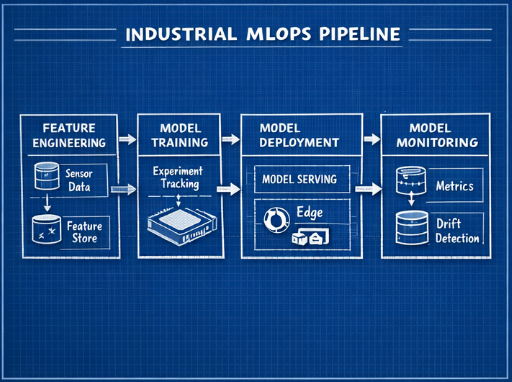
Industrial MLOps pipelines typically include:
- Data ingestion
- feature engineering
- model training
- model validation
- model deployment
- model monitoring
MLOps ensures that models can be continuously improved and reliably deployed.
4. Model Serving Layer
Once models are trained, they must be deployed to perform inference.
Industrial environments require several inference modes:
- real-time inference
- batch inference
- edge inference
Common serving technologies:
| Use Case | Technology |
|---|---|
| Online inference | KServe |
| Model deployment | Seldon |
| API serving | FastAPI |
| GPU inference | NVIDIA Triton |
Low latency is critical for many industrial applications.
5. AI Monitoring & Observability
AI models degrade over time due to:
- data drift
- concept drift
- process changes
- equipment replacement
Monitoring systems track:
- model accuracy
- feature drift
- prediction distributions
- inference latency
Typical monitoring tools include:
| Monitoring Type | Tool |
|---|---|
| Metrics | Prometheus |
| Visualization | Grafana |
| ML monitoring | Evidently AI |
| Logging | ELK Stack |
Without monitoring, AI models may silently degrade in production.
Industrial AI Deployment Patterns
Industrial AI systems are deployed in several architectural patterns.
Edge AI
Edge AI executes models directly on the factory floor.
Advantages include:
- low latency
- offline operation
- reduced cloud bandwidth usage
Typical edge hardware:
- NVIDIA Jetson
- industrial PCs
- edge Kubernetes clusters (K3s)
Common use cases:
- visual inspection
- anomaly detection
- robotics control
Cloud AI
Cloud-based AI platforms provide centralized infrastructure for model training and large-scale analytics.
Advantages include:
- massive compute resources
- centralized management
- simplified MLOps pipelines
Typical use cases:
- predictive maintenance
- fleet analytics
- process optimization
Edge vs Cloud AI Architecture
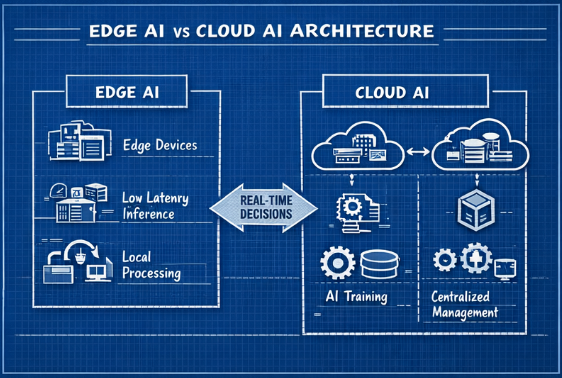
Most factories implement a hybrid architecture:
Edge AI → Real-time inference Cloud AI → model training and optimization
This architecture balances latency, scalability, and operational efficiency.
Example Industrial AI Use Cases
Predictive Maintenance
Sensors monitor machine health metrics such as:
- vibration
- temperature
- pressure
AI models can predict failures including:
- bearing degradation
- motor faults
- abnormal operating conditions
Visual Quality Inspection
Computer vision systems detect manufacturing defects including:
- scratches
- surface contamination
- assembly errors
Common technologies include:
- YOLO
- ResNet
- Vision Transformers
Process Optimization
AI models can optimize production processes by improving:
- yield
- machine parameters
- energy efficiency
Common optimization methods include:
- reinforcement learning
- Bayesian optimization
Security Considerations
Industrial AI platforms must be secured against cyber threats.
Key security practices include:
- secure data ingestion pipelines
- encrypted model artifacts
- role-based access control
- audit logging
Additionally, IT and OT networks must remain properly segmented.
Design Considerations for Industrial AI Platforms
Several architectural challenges must be considered.
Data Quality
Industrial sensor data is often noisy or incomplete.
Robust preprocessing pipelines are essential.
Real-Time Requirements
Some AI use cases require millisecond latency.
This often requires edge AI deployment.
Model Lifecycle Management
AI platforms must support:
- model versioning
- rollback capabilities
- reproducible training pipelines
OT System Integration
AI outputs often need to integrate with:
- SCADA
- MES
- control systems
Careful validation is required before connecting AI outputs to control loops.
Conclusion
Industrial AI platforms enable factories to move beyond simple data collection toward data-driven operations.
By combining:
- industrial data pipelines
- real-time streaming architectures
- scalable AI infrastructure
- mature MLOps practices
manufacturers can deploy reliable AI systems at scale.
The biggest challenge is not building machine learning models —
it is building the platform that runs them reliably in production.
Next Blueprint
The next article in this series will explore:
➡ Blueprint #4 — Industrial Computer Vision Architecture
This blueprint will explain how factories deploy large-scale AI vision inspection systems for automated quality control.