Blueprint #4 -- Industrial Computer Vision Architecture
Blueprint #4 - Industrial Computer Vision Architecture
Modern smart factories increasingly rely on AI-based computer vision for quality inspection, safety monitoring, and production analytics.
Traditional machine vision systems were rule-based and rigid. Today’s factories deploy deep learning models running on edge GPUs capable of detecting defects, anomalies, and operational risks in real time.
This blueprint explains how to design a scalable Industrial Computer Vision architecture integrating:
- Edge AI inference
- Real-time video streaming
- Model lifecycle management
- Industrial data pipelines
Industrial Computer Vision Challenges
Massive Video Data
Source Data Rate —————— ————- 4K Camera 10–20 Mbps Multiple Cameras 100+ Mbps 24/7 Operation TBs per day
Sending raw video to the cloud is not practical for most factories.
Low Latency Requirements
Inspection decisions must occur in milliseconds.
Examples include:
- PCB defect detection
- Bottle fill level inspection
- Surface scratch detection
These workloads require edge inference close to the production line.
Harsh Industrial Environments
Factories introduce additional constraints:
- unstable lighting
- vibration
- dust
- legacy PLC integration
- isolated industrial networks
Architectures must therefore be resilient and autonomous.
Industrial Computer Vision Architecture
The recommended architecture separates workloads into four layers:
- Vision Edge Layer
- Edge AI Processing
- Industrial Data Platform
- AI Model Lifecycle
Architecture Overview
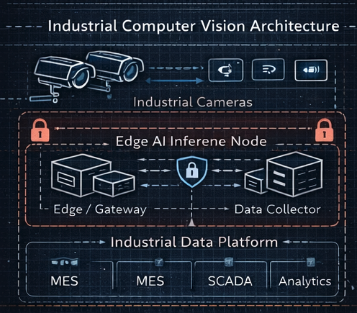
Vision Edge Layer
Industrial cameras generate continuous video streams.
Typical devices include:
- GigE industrial cameras
- USB3 vision cameras
- smart cameras
Protocols:
- RTSP
- GigE Vision
- USB Vision
These streams are processed by edge AI inference nodes.
Edge AI Processing
Edge servers run GPU‑accelerated inference pipelines.
Component Technology —————— ——————————– Edge compute NVIDIA Jetson / Industrial GPU Inference engine TensorRT Vision models YOLO / Detectron2 Video pipeline GStreamer Runtime Docker
Typical pipeline:
Camera → Video Capture → Pre‑Processing → AI Inference → Detection → Event Generation
Only metadata and results are sent upstream.
Industrial Data Platform
Vision results integrate with the broader factory data platform.
System Purpose ———– ———————- Kafka Event streaming Data Lake Image storage MES Quality inspection SCADA Alarm monitoring BI tools Production analytics
Example event:
1
2
3
4
5
6
{
  "camera_id": "line3_cam2",
  "timestamp": "2026-03-15T10:21:00",
  "defect_type": "surface_scratch",
  "confidence": 0.94
}
AI Model Lifecycle
Industrial AI systems require continuous improvement.
Lifecycle steps:
- Data Collection
- Annotation
- Model Training
- Evaluation
- Deployment to Edge
Common tools:
Component Example ——————— —————————- Dataset storage S3 / Data Lake Annotation CVAT Training PyTorch Experiment tracking MLflow Deployment Kubernetes / Edge registry
Edge Vision Processing Pipeline
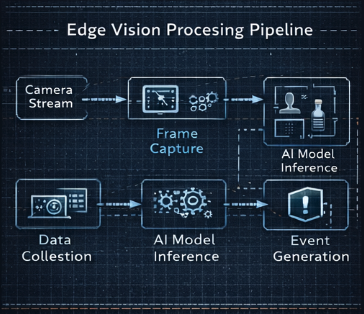
Frame Capture
Frames are captured at:
- 30–60 FPS
- high resolution
Using tools such as:
- OpenCV
- GStreamer
Pre‑Processing
Typical steps:
- resizing
- normalization
- cropping
- color conversion
AI Inference
Task Example —————— ——————– Object detection missing components Classification defect types Segmentation surface anomalies Pose estimation robot inspection
Popular models:
- YOLOv8
- EfficientDet
- Mask R‑CNN
Event Generation
Inference results become factory events.
Examples:
1
2
3
4
defect_detected
worker_without_helmet
missing_component
product_orientation_error
Events are typically streamed through Kafka or MQTT.
Industrial Vision AI Lifecycle
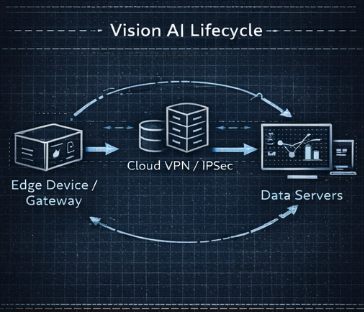
Data Collection
Edge nodes store:
- defect images
- false positives
- rare edge cases
These datasets are used for model retraining.
Data Annotation
Common tools:
- CVAT
- Label Studio
- Supervisely
Model Training
Training normally runs on centralized GPU clusters.
Stack example:
1
2
3
4
PyTorch
CUDA
Distributed training
Data augmentation
Continuous Deployment
Validated models are deployed through:
- container registry
- OTA updates
- edge orchestration
Edge nodes automatically pull the latest version.
Security Considerations
Important controls:
- network isolation
- signed AI models
- secure boot for edge devices
- encrypted storage
- remote attestation
Scalability Strategy
Factories may deploy hundreds of cameras.
Strategies:
- horizontal edge scaling
- distributed event streaming with Kafka
- centralized model registry
Key Design Principles
Successful industrial computer vision platforms follow several principles:
Edge‑First Processing
Perform inference close to machines.
Event‑Driven Architecture
Transmit only results instead of full video streams.
Continuous Learning
Models evolve with production changes.
Industrial Integration
Vision systems integrate with MES, SCADA, and ERP.
Smart Factory Blueprint Series
- Blueprint #1 – Industrial Data Pipeline Architecture
- Blueprint #2 – Industrial Streaming Architecture
- Blueprint #3 – Industrial AI Platform Architecture
- Blueprint #4 – Industrial Computer Vision Architecture
- Blueprint #5 – Industrial Digital Twin Architecture
- Blueprint #6 – Industrial Edge Computing Architecture
Image files expected in:
/assets/img/blueprints/
Required images:
blueprint4-computer-vision-architecture.png blueprint4-edge-vision-pipeline.png blueprint4-vision-ai-lifecycle.png