Blueprint #1 – Industrial Data Pipeline Architecture for Smart Factory Systems
Introduction
Smart factory environments generate large volumes of operational data from PLCs, sensors, and industrial control systems.
Modern industrial architectures must reliably collect, transport, process, and visualize this data while maintaining operational stability. Unlike typical IT systems, industrial environments often operate under strict reliability requirements and constrained network conditions.
This article introduces a vendor-neutral architecture for building an industrial data pipeline using OPC-UA, streaming systems, and cloud-native microservices.
Industrial Data Pipeline Overview
A typical industrial data platform consists of multiple architectural layers that separate field data collection from cloud processing services.
Field Equipment
↓
OPC-UA Server
↓
Data Collection Layer
↓
Streaming Platform
↓
Cloud Processing Services
↓
Data Storage
↓
Monitoring & Analytics
This layered architecture improves reliability, scalability, and operational maintainability.
Reference Architecture
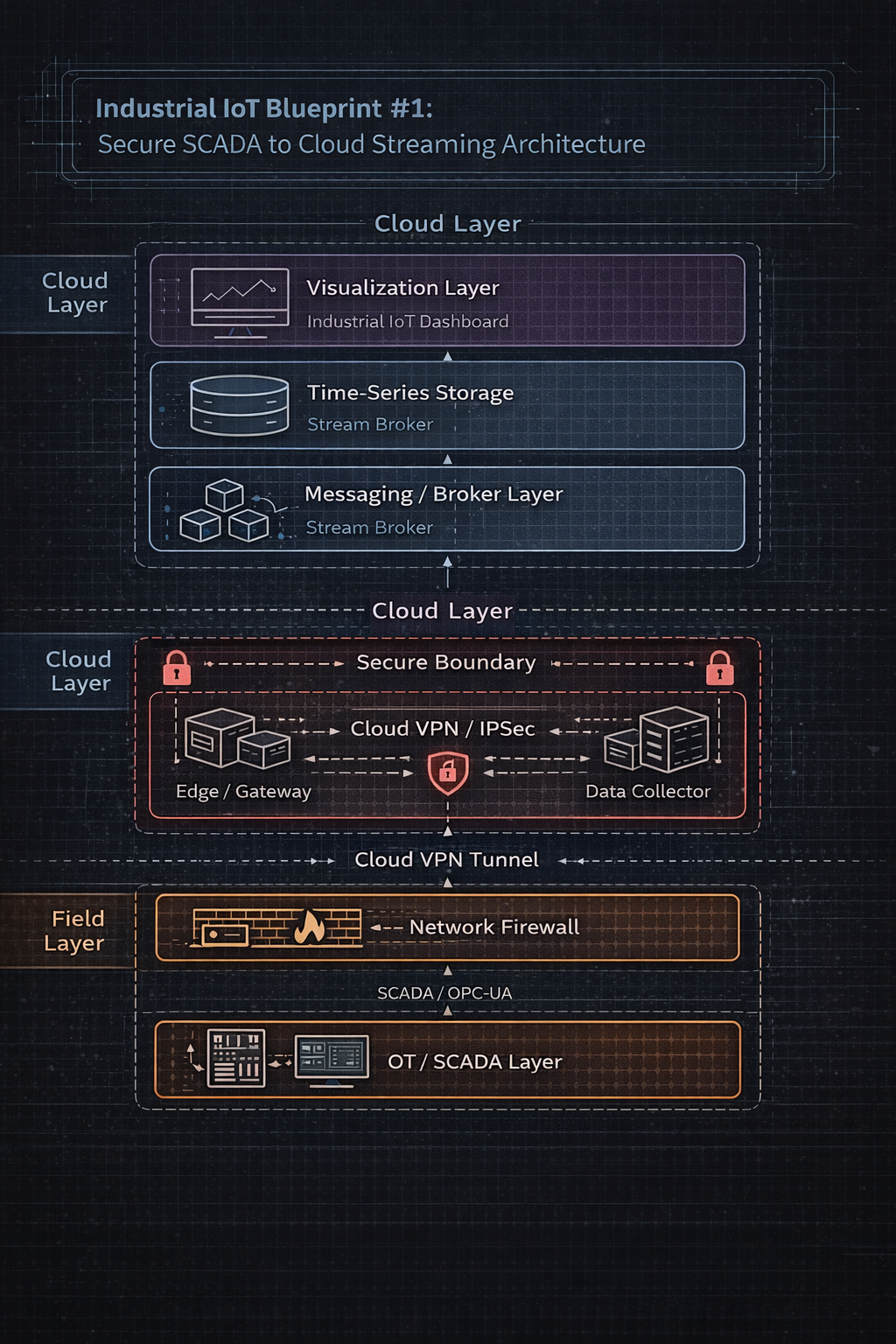
Vendor-neutral reference architecture for industrial data pipelines.
Data Characteristics
Industrial monitoring platforms typically process multiple classes of operational data.
Telemetry Data
- Sampling interval: 1 minute
- Data type: analog telemetry
- Usage: historical monitoring and performance analysis
Telemetry data represents continuous operational measurements such as temperature, power output, or equipment status.
Alarm / Event Data
- Sampling interval: ~3 seconds
- Data type: digital event signals
- Usage: operational monitoring and alerting
Alarm data requires faster processing because it reflects system events that may require immediate operator awareness.
Separating telemetry and event pipelines helps optimize both reliability and processing latency.
Data Collection Layer
In many industrial environments, field data is not transmitted directly to cloud platforms.
Instead, a collection layer is introduced to provide protocol abstraction and operational stability.
Typical components include:
- OPC-UA Client Agent
- Data Collection Middleware Server
The OPC-UA client agent collects data from field OPC-UA servers, while the middleware server forwards normalized data to upstream systems using socket-based transmission.
This layer provides several advantages:
- protocol abstraction
- buffering of field data
- isolation between operational networks and cloud platforms
Streaming Architecture
To support scalable data processing, collected industrial data is transmitted to a distributed streaming platform.
Streaming architectures decouple data ingestion from downstream processing services.
Key benefits include:
- asynchronous processing
- scalable event distribution
- service decoupling
- improved system resilience
A streaming backbone enables multiple processing services to consume operational data without tightly coupling system components.
Cloud Processing Platform
Cloud processing services run on container orchestration platforms where individual processing services are deployed as microservices.
Each microservice performs specific processing tasks such as:
- data normalization
- aggregation
- event processing
- data transformation
Running services as containerized workloads provides several operational benefits:
- independent service deployment
- horizontal scalability
- improved fault isolation
- simplified system evolution
Design Considerations
Designing industrial data platforms requires careful consideration of several constraints that are unique to operational environments.
Real-World Industrial Constraints
Industrial environments differ significantly from traditional IT systems. Network connectivity may be unstable, field devices may have limited resources, and operational continuity is critical.
Architectures must therefore prioritize reliability and fault tolerance over rapid feature deployment.
Reliability & High Availability
Industrial monitoring systems must remain operational even during partial component failures.
Typical strategies include:
- redundant data collectors
- replicated streaming clusters
- distributed processing services
- resilient storage systems
These mechanisms ensure that monitoring services remain available during infrastructure disruptions.
Security & Network Boundary
Industrial environments often enforce strict network segmentation between operational technology (OT) systems and enterprise or cloud environments.
Secure boundaries such as VPN tunnels or gateway layers are commonly used to control data flow between field networks and cloud platforms.
Maintaining this separation is essential for protecting operational systems.
Scalability
Industrial data platforms must support increasing numbers of sensors, devices, and monitoring points.
Using microservices and distributed streaming systems enables horizontal scaling as operational data volumes grow.
Lessons Learned
Designing industrial data platforms requires a strong focus on reliability, operational stability, and architectural separation of concerns.
Several architectural principles are particularly important:
- separate data collection from data processing
- use streaming systems to decouple system components
- isolate operational networks from cloud environments
- design for failure rather than assuming stable infrastructure
These design principles help industrial systems maintain long-term reliability while supporting scalable data processing capabilities.
Conclusion
Smart factory environments require robust data platforms capable of collecting, processing, and visualizing operational data at scale.
By separating data collection, streaming, and processing layers, industrial platforms can achieve both reliability and scalability.
This architecture pattern is increasingly adopted in modern industrial IoT and smart factory systems.